Every Document You Need for Government Job Document Verification in India — Complete Checklist (2026)
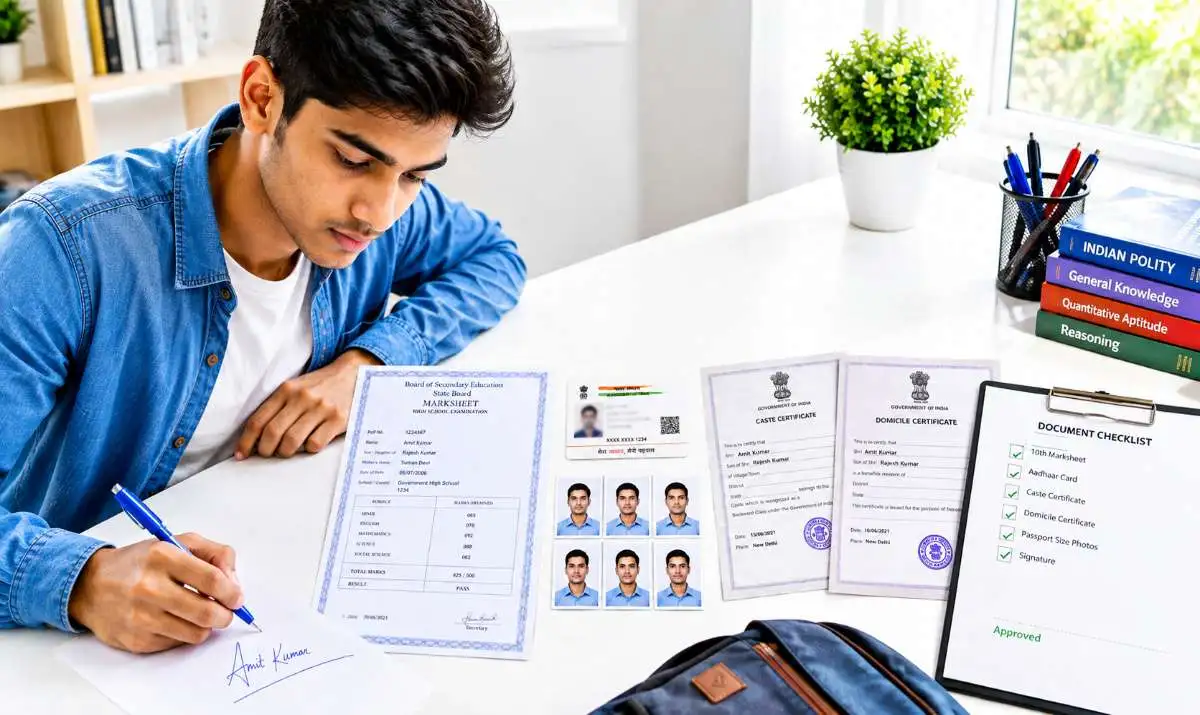
The hardest stage of a government job is not the exam — it is the document verification (DV). Every year, thousands of candidates clear the written test, physical assessment, and interview, only to be disqualified at DV because one certificate was missing, expired, or had a spelling mismatch. In SSC CGL 2024 alone, roughly 4% of candidates who reached DV were disqualified due to document issues — that translates to thousands of lost seats. This guide covers every document required at DV for UPSC, SSC, Railway, UPPSC, UPSSSC, Banking, and state-level recruitments, with specific guidance on what goes wrong and how to prevent it.
Educational Documents — The First Thing Checked
10th Marksheet and Certificate
The first document the DV officer picks up. The 10th marksheet establishes three things — date of birth (age eligibility), the starting point of educational qualification, and the name that every other document must match. If the 10th marksheet reads “Rajesh Kumar” but the Aadhaar says “Rajesh Kumar Verma,” the mismatch gets flagged immediately. The DV officer treats the 10th marksheet as the master document — everything else must align with it.
Carry the original plus 2 self-attested photocopies. Keep a digital copy on DigiLocker (digilocker.gov.in) as backup — several recruitment boards now accept DigiLocker-linked documents.
12th and Graduation / Post-Graduation Marksheets + Degree
Every marksheet and degree up to the minimum educational qualification (Essential Qualification) specified in the notification is required. SSC GD Constable (10th pass) needs only the 10th marksheet. UPSC CSE requires a graduation degree. UPPSC RO/ARO requires graduation with specific subject requirements. Read the “Essential Qualification” section of the notification carefully — a provisional certificate (issued by the university before convocation) is accepted in place of the degree at DV, but if the actual degree has been issued, bring that instead.
CGPA to Percentage Conversion
Some recruitment boards specify a minimum percentage (for example, RBI Grade B requires 60% for General, 55% for SC/ST). If your university uses CGPA instead of percentages, you need an official CGPA-to-percentage conversion certificate from the university. Your own calculation will not be accepted — the DV officer needs the university’s official letter.
Age Proof — A Single Day’s Difference Can Cost the Seat
Date of Birth Verification
Government job age limits are the strictest eligibility condition — even one day above or below the cutoff disqualifies you. UPSC CSE 2026 requires 21–32 years (General), UPPSC PCS requires 21–40 years, SSC CGL requires 18–32 years. Age relaxation applies: SC/ST 5 years, OBC 3 years, PwBD 10 years, ex-servicemen 3–5 years. Age is calculated from the “crucial date” specified in the notification (usually 1 January or 1 July).
The 10th marksheet is the primary age proof. If the date of birth on the 10th marksheet differs from the Aadhaar, the 10th marksheet is treated as authoritative — not the Aadhaar. However, this mismatch itself is a red flag that invites additional scrutiny. The date of birth should be identical across all documents. If there is a difference, get the Aadhaar corrected at a UIDAI Seva Kendra — not the 10th marksheet.
Caste Certificate — The Only Proof of Reservation Claim
SC/ST Caste Certificate
Lifetime validity. Carry original plus 2 self-attested copies to DV. The caste name must exactly match the spelling in the Presidential Order — “Chamar” and “Charmakar” are separate entries, and writing one instead of the other causes rejection at DV. The SDM or Tehsildar issues it through the state eDistrict portal — most states charge ₹10–30 with 7–15 working days processing.
For UPSC and some central recruitments, a District Magistrate-level certificate may be required rather than a Tehsildar-level one. Check the “issuing authority” specification in the notification. The UPSC notification explicitly lists the acceptable authorities — DM, ADM, Collector, DC, Additional DC, Deputy Commissioner, 1st Class Stipendiary Magistrate, City Magistrate, SDM, Tehsildar, or Revenue Officer.
OBC Non-Creamy Layer (NCL) Certificate
This is where the most DV rejections happen. OBC NCL validity is limited — for central recruitments (UPSC, SSC, Railway, Banking), it is valid for 1 financial year (April 1 to March 31). The NCL must belong to the financial year in which the “crucial date” falls. If the DV is in 2026–27, you need an NCL issued after April 1, 2026.
The NCL income threshold is ₹8 lakh per year. A critical DoPT clarification that most candidates miss: salary income and agricultural income are both excluded from the NCL calculation. What this means in practice: a father earning ₹6 lakh salary in a government job plus ₹3 lakh from agriculture = ₹0 in NCL calculation (both excluded) = NCL valid. But ₹6 lakh from business plus ₹3 lakh from rent = ₹9 lakh (neither excluded) = NCL invalid because it exceeds ₹8 lakh.
The central OBC list (ncbc.nic.in) and the state OBC list are different. UPSC, SSC, and Railway use the central list. UPPSC and UPSSSC use the state list. Bringing a certificate based on the wrong list means DV failure — even if your caste is legitimately listed in the other.
Domicile Certificate — Required for State-Level Recruitments
When You Need It
UPPSC PCS, UPSSSC PET/Lekhpal/Junior Assistant, UP Police SI/Constable, UP Judiciary — every state-level recruitment in Uttar Pradesh requires a UP domicile certificate. Central recruitments like UPSC, SSC, and Railway generally do not require a domicile certificate, though some posts may ask for one for regional or zonal allocation.
The permanent domicile (Mool Niwas Praman Patra) is required, not the ordinary residence certificate. The eDistrict UP portal processes it through eSathi for ₹10–15, with Family ID (familyid.up.gov.in) as a mandatory prerequisite, and processing takes 7–15 working days. The certificate has lifetime validity, but some recruitment notifications specify that it should not be older than 3 years — read the notification carefully.
Income Certificate — For EWS and Specific Posts
When You Need It
The income certificate is mandatory for EWS (10% reservation) claims — it serves as the base document for obtaining the EWS certificate. Some Group C and D posts have income-based eligibility criteria. Scholarship and fee reimbursement schemes also require it.
The Tehsildar issues it under the Revenue Department. In UP, the validity is 3 years, but when getting the EWS certificate made, a fresh income certificate is preferable because the EWS certificate should reflect the current financial year’s income.
EWS Certificate — The Document That Expires When You Least Expect It
The Most Commonly Expired Document at DV
The EWS certificate expires every March 31 — regardless of when it was issued. The SSC CGL 2025 exam was held in March, but DV was in September — the March certificate had expired on March 31. Get a fresh one from the current financial year. Eligibility: General category only, family income below ₹8 lakh, agricultural land less than 5 acres, residential flat less than 1000 sq ft. SC/ST/OBC candidates are not eligible for EWS.
Character Certificate — For Police and Security Forces
When You Need It
UP Police SI/Constable, SSC GD Constable, CISF, BSF, CRPF, ITBP, SSB, Railway RPF — every armed and paramilitary recruitment requires a character certificate. Some Group B posts also require it. Validity is 6 months to 1 year — if it was issued more than 6 months before the DV date, it may be treated as expired.
Character Certificate ≠ Police Clearance Certificate
This confusion is extremely common. The character certificate is issued by the revenue authority (Tehsildar) — processed through the eDistrict portal. The Police Clearance Certificate (PCC) is issued by the police department — through the police station or SSP office. These are two different documents from two different authorities for two different purposes. If the notification says “Character Certificate,” get it from the Tehsildar. If it says “Police Verification Certificate” or “PCC,” get it from the police. Bringing the wrong one means the DV officer will not accept it.
Identity and Address Proof — Aadhaar, PAN, and Voter ID
Aadhaar Card
The primary identity document at DV. Every recruitment board requires it. Name, date of birth, and address must match the 10th marksheet and all other documents. If there is a mismatch, get it corrected before DV — online correction takes 2–4 weeks, and a Seva Kendra visit takes 1–2 weeks.
PAN Card
Issued by the Income Tax Department. Not mandatory for all recruitments, but required for Banking (IBPS PO/Clerk, RBI), Insurance (LIC AAO), and some Group A/B posts. The name must match the 10th marksheet.
Voter ID
Additional identity proof. Not mandatory for most recruitments, but the DV officer may ask for a backup identity document. If you are 18+ and don’t have a Voter ID, apply online through NVSP (National Voter Service Portal).
Photos, Signature, and NOC — Small Documents That Create Big Problems
Passport Size Photographs
Carry 6–10 recent passport size photographs (3.5cm × 4.5cm) — white background, formal attire, without glasses (unless prescribed). Some boards require the date printed on the photograph — check the notification. Mobile camera selfies are not accepted — get them done at a professional studio.
Signature Matching
The signature you used on the application form must be replicated at DV — the officer checks for consistency. If your signature has changed over time, practice reverting to the original pattern before DV.
NOC (No Objection Certificate)
If you are already employed in a government position and attending DV for a different recruitment, a No Objection Certificate from your current employer is mandatory. Without it, the DV officer will not proceed — even if you are willing to resign. Getting a NOC can take 2–4 weeks — apply immediately when the DV call letter arrives.
Medical and Physical Certificates — For Police and Military Recruitments
When Required
UP Police, SSC GD, CRPF, BSF, NDA — all recruitments with physical tests may require a medical fitness certificate and physical measurement certificate (height, chest, weight) at the DV stage. The certificate must be from a government hospital — Civil Surgeon, CMO, or PHC Doctor. Private hospital certificates are generally not accepted.
DV Day Checklist — At a Glance
| Document | Original | Self-Attested Copies | Issued By |
|---|---|---|---|
| 10th Marksheet + Certificate | ✅ | 2 | Board |
| 12th Marksheet | ✅ | 2 | Board |
| Graduation Degree / Provisional | ✅ | 2 | University |
| Caste Certificate (SC/ST/OBC NCL) | ✅ | 2 | Tehsildar/SDM — eDistrict |
| Domicile Certificate | ✅ | 2 | Tehsildar — eDistrict |
| Income Certificate | ✅ | 2 | Tehsildar — eDistrict |
| EWS Certificate (General only) | ✅ | 2 | Tehsildar — eDistrict |
| Character Certificate | ✅ | 2 | Tehsildar — eDistrict |
| Aadhaar Card | ✅ | 2 | UIDAI |
| PAN Card | ✅ | 2 | Income Tax Dept |
| Passport Size Photos | — | 6–10 | Studio |
| DV Call Letter | ✅ | 2 | Recruitment Board |
| Admit Cards (all stages) | ✅ | 2 | Recruitment Board |
| NOC (if currently employed) | ✅ | 2 | Current Employer |
| Medical Certificate (if applicable) | ✅ | 2 | Civil Surgeon / CMO |
Every document: original plus 2 self-attested photocopies. Self-attested means signing the photocopy with “certified that this is a true copy” or “प्रमाणित प्रति” written by hand.
5 Mistakes That Cost Seats Every DV Season
1. OBC NCL has expired. The single most common DV failure. For central recruitments, the NCL must belong to the current financial year. Check NCL validity the moment the DV call letter arrives — if expired, apply for a fresh one immediately. Processing takes 7–15 days. If the DV date is close, visit the Tehsil office in person and explain the urgency.
2. Name mismatch across documents. “Suresh Kumar” on the 10th marksheet, “Suresh Kumar Yadav” on Aadhaar, “सुरेश कुमार यादव” on the caste certificate — three documents, three different versions of the same name. The DV officer treats the 10th marksheet as the master. Align all other documents to match it — correct Aadhaar through UIDAI, and get fresh certificates through eDistrict with the matching name.
3. EWS expired on March 31. DV is in August, but the EWS was obtained in January — it expired on March 31. Get a fresh EWS from the current financial year (issued after April 1, 2026).
4. Brought a character certificate instead of PCC (or vice versa). Two different documents from two different authorities. Check the exact wording in the notification. “Character Certificate” means Tehsildar (eDistrict). “Police Verification” means police station or SSP office.
5. Brought only photocopies, no originals. DV requires original verification — the officer inspects the original and keeps the photocopy. Photocopies alone are treated as incomplete. Keep DigiLocker as backup — some boards accept digital documents if originals are lost, but this is not guaranteed.
How Far in Advance to Start Preparing
| Timeline | Action |
|---|---|
| 6 weeks before DV | Check validity of all certificates — OBC NCL, EWS, Character Certificate |
| 5 weeks before | Apply on eSathi / eDistrict for any expired or missing certificates |
| 4 weeks before | Aadhaar / PAN name correction if mismatch exists |
| 3 weeks before | NOC from current employer (if applicable), medical certificate (if applicable) |
| 2 weeks before | Download all certificates, prepare 2 self-attested copies each, sync DigiLocker |
| 1 week before | Arrange everything in a transparent folder — match against the notification’s checklist |
| DV day | Originals + copies + photos + call letter + all admit cards — carry everything |
The 6-week buffer exists because certificates like OBC NCL and EWS take 7–15 working days to process, and Aadhaar corrections take 2–4 weeks. Start the countdown the moment the DV call letter arrives — no new certificate can be created in the last week.
Preparing for a government job is not just about completing the syllabus — document preparation is an inseparable part of it. Candidates who sort their documents alongside their exam preparation walk into DV with nothing to worry about except their merit. Those who start this work after receiving the DV call letter find themselves trapped between processing times and expired certificates, losing seats they earned through months of hard work — not because they lacked the qualification, but because a piece of paper was not in their folder.